Monday, December 28, 2009
Flying with a Toddler - Optimal Boarding Technique
Monday, June 29, 2009
Killing Me Softly (with his song)
I also remembered that the Fugees covered the song but I had never actually heard the original version. So with the help of the internet, which barely existed in 1996, I set out on a search for the original. An article in Blender gives the following synopisis:
“KILLING ME SOFTLY With His Song” might be pop’s most misunderstood tune of all time. It’s surrounded by so many myths, it makes Aesop’s fables look like reality TV. Millions of pop fans know that Roberta Flack wrote the song about Don McLean – killing her softly with his song “American Pie” – and that the Fugees made it a smash more than 20 years later.I was able to find YouTube videos of all three artists' versions as well as the Don McLean song that inspired Lori Lieberman in the first place. Here the are, starting with the Fugees:
Interesting, but not true. Yes, Flack took this classic lovelorn weepie to number 1 in February 1973. But she didn’t write it.
“When Roberta’s version came out,” McLean recalls, “somebody called me and said, ’Do you know there’s a song about you that’s number 1?’ I said, ’What – are you kidding?’ And they said, “The girl who originally recorded it had it written for her after she saw you at the Troubadour in Los Angeles. She went on TV and talked about it.”
The girl was an L.A. folkie named Lori Lieberman. “I thought [McLean] was just incredible,” she says. “He was singing songs that I felt pertained to my life.” But it wasn’t “American Pie” that got her scribbling – it was a lesser-known album track called “Empty Chairs.”
Roberta Flack:
and Lori Lieberman:
Finally here is the Don McLean song "Empty Chairs":
As a post script, I have actually been made fun of for singing the Fugees version at a karaoke bar. It was a bit hard to hit the notes, but thankfully the Plain White T's have a version that might be a bit easier:
I am glad they include the counting...
Tuesday, May 05, 2009
Chrysler Bankruptcy Legal Analysis
Friday, February 27, 2009
Data on the CDO Mess
Here are the key paragraphs from the FT report:
The conclusions are stunning. From late 2005 to the middle of 2007, around $450bn of CDO of ABS were issued, of which about one third were created from risky mortgage-backed bonds (known as mezzanine CDO of ABS) and much of the rest from safer tranches (high grade CDO of ABS.)
Out of that pile, around $305bn of the CDOs are now in a formal state of default, with the CDOs underwritten by Merrill Lynch accounting for the biggest pile of defaulted assets, followed by UBS and Citi.
The real shocker, though, is what has happened after those defaults. JPMorgan estimates that $102bn of CDOs has already been liquidated. The average recovery rate for super-senior tranches of debt – or the stuff that was supposed to be so ultra safe that it always carried a triple A tag – has been 32 per cent for the high grade CDOs. With mezzanine CDO’s, though, recovery rates on those AAA assets have been a mere 5 per cent.
Let me put this in context of what was going on with structured finance at the time i.e. packaging individual mortgages in to bonds and then repackaging those bonds. The first picture below shows a typical mortgage backed security. An investment bank would purchase a bunch of mortgages (usually thousands) and pool them together so that all of the principle and interest payments would go into one fund. The investment bank would then create a series of bonds that they could sell to investors. Within this series of bonds would be low risk bonds that wold be paid first, moderate risk bonds that would be paid second, and high risk bonds that would only be paid if the first two groups were paid.
The investment banks had a fairly easy time selling the low risk bonds to conservative investors. Actually these bonds are still doing OK because even after foreclosure houses are never worth $0. They also didn't have much trouble selling the high risk bonds to risk taking investors because they had very high yields. These have turned out to be bad investments but they are really not a big part of the problem because the investors knew that they were high risk to begin with. The problem for the investment banks is that according to the FT report, from 2005-2007 the investment banks had $450bn of moderate risk bonds that were difficult to sell and if they could not find find something to do with them they would not make back the money that they spent on the mortgages in the first place. The solution was to repackage these moderate risk mortgage backed bonds with other moderate risk mortgage backed bonds to create some new low risk bonds that they could sell to conservative investors. The picture below shows how this would work.
So keep in mind what this report is saying. It says that the $450bn of asset backed bonds that were hard to sell in the first place and hence were packaged into CDOs and resold are in reality turning out to be terrible investments. So it would appear that the investors who initially balked at purchasing "moderate risk" bonds were not far off the mark. The problem of course is that repackaging these bonds as CDOs did not do anything to reduce the risk and the reason for that is that all of the "moderate risk" bonds are failing in the same way - the payouts to the low risk bonds in each series are eating up all of the principle and interest payments each month leaving very little for the moderate risk bonds. That was the correlation that everyone missed.
Also keep in mind what this report is not saying. It is not talking about how the low risk portions of the original mortgage backed security are doing. That is a much bigger piece of the total pie than this $450bn. As of now, many of the Markit indexes AAA indices are still doing ok, although they have taken significant losses since my last post on the topic. The troubling thing of course is that if the moderate risk bonds are taking such huge loses now how will the low risk bonds preform in the future?
Tuesday, February 24, 2009
A Proposal on How to Clean Up the Banks
This is an interesting proposal to limit the downside for taxpayers and give bank shareholders some hope to keep their investments from going to zero.
I have two concerns about the plan:
1. It assumes that the government can sell these toxic assets for something like their hold to maturity value sometime within the next two years. I am not sure that this is a valid assumption given that most of the MBS's and CDO's were not really meant to trade in the aftermarket. They were meant to be sold once, at their par value, and then held to maturity. Now that we know that these assets are not worth their par value, any buyer would only pay a significant discount to their hold to maturity value, which I believe is non-zero. It is not clear to me that a realistic value can be put on these assets anytime in the next two years. More likely we would have to wait 10 years to see how the assets actually performed and then calculate their value from that.
2. A related point is that this plan also assumes that bank executives and shareholders would be willing to give the government control over their destinies. Granted, they may already be past the point of stopping bankruptcy or nationalization, but if they participate in this plan they are essentially betting their jobs and/or their money on how much their assets can fetch.
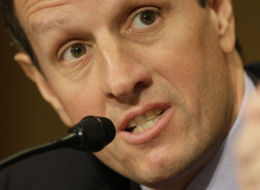
About Timothy Geithner
Read the Article at HuffingtonPost
Friday, November 14, 2008
Wednesday, October 15, 2008
McCain: Inarticulate on Health Care
In my view, the issue of how to reform health insurance is the most important domestic issue that will be decided in the next several years. Either we grant the state a bigger role health care or we allow individuals more freedom. We really cannot have both and I would certainly choose the later.
Unfortunately, as evidenced by my friend Rob's recent post, which compared and contrasted the candidates views on health care, McCain is doing a terrible job of articulating what increasing health care freedom means for Americans. So as it becomes less and less likely that anything that I want to happen is actually going to happen let me try to explain what McCain should have said.
The government creates two big problems with health care: Employer based insurance and minimum coverage requirements. Lets take a look at each of these problems and how the government can solve them.
Problem 1: Employer Based Health Insurance
Most Americans receive their health insurance as a benefit from their employer due to federal government tax policy. The policy states that if a business purchases health insurance for its employees, it can deduct the money it spends on health insurance from its taxes just like it deducts the money spent on employee salaries. The federal government does not allow individuals to deduct money spent on health insurance from their taxes. So when most companies and their employees do the math it works best for businesses to buy health insurance for their employees. However at least three problems with this situation have become apparent:
- Companies have insurance options, but employees do not: If the company is the one purchasing the health insurance, they are the ones that choose which insurance to buy. They may choose to give their employees some limited options, but at the end of the day the business with likely look out for its own interests not necessarily those of its employees. Likewise, the insurance company looks at the business as their customer, not the employees. So when it comes down to making the business happy or making the employees happy the insurance company will try to please it the business, its customer. This contributes to frustration with "insurance".
- No portability of care: When people get their health insurance through their employer, by definition if they change jobs, they have to change insurance. This creates a problem if someone needs to change jobs when that person or a family member is going through an illness. So the person is left with either not changing jobs or potentially dealing with denial of coverage due to the preexisting condition. Just like it does not make sense to change property, auto, or life insurance when changing jobs, it does not make sense to change health insurance when changing jobs either.
- The Part-Time Cracks: The previous two problems make health insurance less convenient for the majority of people with a single steady job. However a significant percentage of people lack health insurance all together because they work at a part time job, or perhaps multiple part time jobs. When a business can amortize the cost of an employee's over 40 hours a week for 52 weeks per year, most times they can make the math work out in favor of supplying health insurance for their employees. When they look at an employee who works less than that, either per week or seasonal employment, they may likely conclude that the costs of health care is not worth it relative the employee's total annual salary. People in these situations fall through the cracks of the employer sponsored health insurance.
The big open issue with this proposal is what happens if individuals choose to leave their employer sponsored insurance plan for a plan that they buy individually. The key assumption to this plan is that by taxing an employer provided health insurance benefit, employees will understand exactly what their employer is paying for health insurance and consider it an explicit part of their salary instead of a difficult to value benefit. So, an employee chooses to leave their employer sponsored plan, they should demand the full value benefit in extra salary, which would give them the extra money to buy that insurance privately.
Problem 2: State Mandated Minimum Coverage
The second government created problem with health insurance is not created in Washington D.C. but finds it genesis in each of the 50 state capitals where legislatures make rules about what types of procedures health insurance has to cover. The classic example is chiropractic care, which many states mandate health insurance cover, but few people actually have any desire to obtain. This is basically a special interest give away by making the majority of people pay higher premiums so that a minority of people can get their specialty care subsidized. Or so that the providers of that specialty care can make more money.
The simple policy change that this country needs is to allow people to purchase health insurance from a company in another state that may have fewer minimum coverages and lower costs. Personally I will never choose to visit a chiropractor, so I would prefer not to hold insurance coverage that covers chiropractic care because it is marginally more expensive and I neither need nor want it.
What is the concern with this? It is not like we are outsourcing health insurance decisions to some third world country. Health insurance would still be regulated by some state and states and insurance companies would have an incentive to make insurance policies more relevant to the individual's needs. That is a good thing as far as I can tell.
Unfortunately we will not get get it because McCain cannot articulate it.
Wednesday, October 08, 2008
Things I Didn't Know About Subprime
Yesterday I read a fascinating paper, The Panic of 2007, by Gary Gorton (via Tyler Cowen) that describes the factors that contributed to the problems in the financial sector. I learned a bunch of interesting things about subprime mortgages, RMBS (the securities used to fund subprime mortgages), and the more arcane financial structures (CDO's and CDS's) that have contributed to this crisis. The following is a list of the interesting things that I didn't previously know:
- Subprime mortgages short term loans - This was a little surprising because I had always thought about mortgages as long term investments that could possibly expire early i.e. refinancing or prepaying principle on a 3o year fixed rate mortgage. It seems that when banks made subprime mortgages, they intended force the borrower to refinance after two or three years. Page 12 starts an interesing discussion of subprime mortgage design. In short the banks intended to make a mortgage loan that would need to be refinanced in just a few years, which they assumed would be possible due appreciation on the home value. Gorton argues that this is tantamount to holding a call option on home prices.
- Subprime backed Residential Mortgage Backed Securities (RMBS) were meant to be short term investments - Again I had usually thought about these bonds as long term investments that might expire early and hence carried prepayment risk. Pages 32 and 33 show a comparison of two subprime backed RMBSs, one issued in 2005 and another issued in 2006. The first thing to strike me about these two deals is that the 2005 deal has already seen prepayments of $836 m on the original $1.2 B of mortgages (70%). In fact the vast majority of the original highest rated (AAA) bonds had been paid off. I would not have thought that less than two years after issuance the so much of this debt would be paid off.
- The problems with RMBS may have more to do with increased duration than market illiquidity - In contrast to the 2005 deal, the bonds associated with the 2006 deal are not seeing anywhere near the amount of prepayments - $518 m on the original $1.3B (40%). So investors and banks are now apparently stuck with bonds on their books that they originally expected to prepay. So it may not be so much the lack of trading as the lack of prepayment that is hurting the credit markets.
- The highest rated bonds (AAA) are still highly rated - My initial impression of the subprime mortgage crisis was that the underlying mortgages were performing so poorly that even the highest rated bonds were losing their AAA ratings. Looking at these two deals, that does not seem to be the case. Only the A4 tranche of the 2006 deal has been downgraded and even that bond still gets a AAA from Moody's. I also took a brief look at an subprime RMBS index mentioned in the paper, the ABX.HE index. Just browsing through the various AAA rated indices shows that many of the original AAA rated bonds still held their rating and many of the ones that didn't still held investment grade ratings. The real carnage appears to be in the mezzanine tranches.
- CDO complexity exposed - I guess that I pretty much understood what was going on with RMBS's being restructured into CDO's but this paper really illustrates how complex the payoff structure is. With multiple checks and tests per layer trying to model the cash flow from these investments is basically impossible. Of course if your expectation is that housing prices will keep rising and that you will get your money back in just a few years it may make sense to invest in something that you do not really understand. I guess that is the thought process.
Friday, July 18, 2008
Big Surprise
Massachusetts residents got a shock when state officials, at the peak of construction on the Big Dig project, disclosed that the price tag had ballooned to nearly $15 billion. But that, it turns out, was just the beginning.It is not completely clear to me from the article how the accounting works here - are they just adding back all of the interest costs until the principle is completely paid?
Now, three years after the official dedication of the Central Artery/Third Harbor Tunnel, the state is reeling under a legacy of debt left by the massive project. In all, the project will cost an additional $7 billion in interest, bringing the total to a staggering $22 billion, according to a Globe review of hundreds of pages of state documents. It will not be paid off until 2038.
Regardless the Massachusetts Turnpike Authority, the agency responsible for maintaining the Mass Pike (I-90) and also the Central Artery (I-93) portion of the Big Dig, currently faces a huge budget deficit due to the interest expense on the Big Dig debt. To deal with this, the agency plans to cut the only discretionary expenses they have - road repairs:
Alan LeBovidge, the turnpike's new executive director, estimates a yawning deficit next year in the authority's operating budget, $70 to $100 million. The capital budget for construction, paving, and inspection for the Big Dig and the 137-mile Massachusetts Turnpike, meanwhile, has been slashed to $22 million, about 19 percent of the debt expense.So this is really great. A good portion of the tolls collected on the Mass Pike are currently being used pay down the debt on the Big Dig, which has almost nothing to do with the Mass Pike. At least one member of the MTA board makes a sensible statement
"It's outrageous that toll-payers wind up footing the bill when others get a free ride," said Mary Z. Connaughton, a Turnpike Authority board member.Yes it is outrageous and there is no end in sight if we continue to leave it to the State to deal with this. In my view the state needs to take two steps to deal with this budget issue:
- Institute tolls on I-93 north and south of the city - the majority of the debt on the MTA books is associated with the Big Dig construction project, but none of the tolls that the MTA collects come from this portion of road. Instituting tolls that are directly related to the construction will at least end the free ride for the commuters who benefit from the construction but have not paid any of the costs.
View Larger Map - Look to the private sector to take on the management of the MTA. Tapping private capital to pay down the debt will immediately bring increased efficiency to the operation and decision making process on I-90 and I-93. When both the Mass Pike and the Central Artery have tolls in place the firms operating will have the opportunity for financial gain by bringing their maintenance costs in line with their revenues. Since these firm will, no doubt, be highly regulated when they try to raise tolls drivers will actually be in a better position because today the regulators are the ones raising tolls.
Thursday, March 06, 2008
Human Error and Traffic Jams
Thursday, November 15, 2007
Hulu
Tuesday, November 06, 2007
Web 2.0 Stuff


Thursday, August 02, 2007
Mankiw's Carbon Theorem
Cap-and-trade = Carbon tax + Corporate welfare
I this theorem just absolutely hits the nail on the head. Politically it looks like some sort of carbon tax or cap-and-trade scheme is coming both for national security and environmental reasons. The real question left is: where will the money from the tax or cap-and-trade scheme go? Will it go to corporations or will it go to the federal government? My favorite suggestion would combine a carbon tax with a reduction on income taxes. Of course I would also favor an increase in federalism in road construction.
Tuesday, July 31, 2007
More OCBP News Coverage
While I was in Ocean City, the CBS Early Show ran a segment about the dangers of digging holes in the sand that featured the the OCBP. Every parent should watch this video because it highlights the dangers and potential deadly consequences of a seemingly safe activity. In addition to Captain Butch Arbin, the video features Lt. Wes Smith warning a kid that his hole was too deep.
The danger of digging holes in the sand recently gained a higher profile when Dr. Bradley Maron and his father published a study on the topic in the New England Journal of Medicine. Here is a Washington Post account of the story.
In other recent Ocean City News, here is a podcast featuring Jesse Houston, Ocean City's Planning Director.
Thursday, July 19, 2007
Look at Your Neighbor!
Fr. Peter began by relating a complement that he had received from a person in the neighborhood about why he is such a good gardener. The person said that Fr. Peter was a good gardener because he looked at his plants. He looked at them to know if they needed water or had too much. He looked at them to know if the soil was too hard or too soft. He looked at them to know if they had too much sun or not enough. Only by looking at his plants could he find out what they needed and fix it.
Now the point of the Good Samaritan, according to Fr. Peter, is that probably only the Good Samaritan bothered to look at the robber's victim. The other travelers on the road probably did not stop because they simply did not take the time to look at the victim. Since they did not take the time to look at him, they could not feel sympathy or compassion for him and thus it did not even occur to them to stop and help. Only the Good Samaritan bothered to look.
Living in the city, I think that this message really hits home for me. How often do I just blow by panhandlers on the sidewalk because I just do not take the time to look at them? How callus do we become when we do not take the time to look at our neighbor?
Saturday, July 14, 2007
Cambridge at Dusk
Thursday, July 12, 2007
"Feed My Sheep"
"If Jesus ran a restaurant, would he use this model?" asked Brad Birky. "We'd like to think so. Not that we're comparing ourselves to Jesus or his work. We're just inspired by him and his work."
Tuesday, July 10, 2007
Dan Savage: Smokin'
Truth in Carbon Taxes
But Mr. Dingell, in an interview to be broadcast Sunday on C-Span, suggested that his goal was to show that Americans are not willing to face the real cost of reducing carbon dioxide emissions. His message appeared to be that Democratic leaders were setting unrealistic legislative goals.
“I sincerely doubt that the American people will be willing to pay what this is really going to cost them,” said Mr. Dingell, whose committee will be drafting a broad bill on climate change this fall.
Today the Wall Street Journal weighed in with an editorial praising Representative Dingell for his his honesty relative to others who would prefer to combat global warming through increased regulatory standards on fuel efficiency, but coming out as opposed to increased fuel taxes nevertheless.
Speaking for ourselves, we don't favor a carbon tax. In theory, such a tax might make sense if it were offset by lower taxes on income tax rates and capital investment--which would be a net plus for economic growth. However, there's not a chance in melting Greenland that the current Congress would offset any new carbon taxes; it would merely pocket the extra revenue to permanently increase the government's share of GDP.
Although I certainly do not trust anyone in Congress to immediately refund any additional gasoline tax revenue, I do support increased gas taxes, although I support them primarily on national security grounds. The Islamic Fundamentalists and the Iranian regime receive the majority of their funding from oil sales so reducing their revenues should be a key component to our strategy. While we cannot immediately cease all foreign oil purchases we can slow the rate of our oil consumption by imposing additional taxes and then use a portion of that money to oppose our enemies.
Of course we would also see some environmental benefits. Benefits that would be much more tangible than those obtained through increased fuel efficiency. Nonetheless, the reason to increase gas taxes is national security not the environment.