I seem to have missed this story last week. In a very positive development, it turns out that the State of Indiana plans to lease the Indiana Toll Road to a private company for a term of 75 years. Macquarie-Cintra, an Australian-Spanish consortium will pay the state $3.8B for the lease and will have management control over the toll road including maintenance and collecting toll revenue. Apparently, Indiana plans to spend the lease money to finance other road improvements in other parts of the state.
I have previously written about the potential of privatizing much of our transportation infrastructure. We need many more of these kinds of deals where government turns over operational responsibility of public assets to private firms. (In fact I would go farther and assert the Indiana should simply sell the toll road to Macquarie-Cintra.)
I found a pretty good financial analysis of the Indiana Toll Road that Crowe Chizek Financial prepared for the state. Currently the tool road has annual revenues of about $95M and annual operating expenses of about $70M. The financial analysis projects these revenues and expenses out for the next 75 years based on a variety of assumptions to reach the conclusion that if the state continued to operate the toll road it would be the equivalent of a public company worth $1.92B. That Macquarie-Cintra is willing to pay $3.8B shows how optimistic the consortium is about its ability increase cash flow!
It will be interesting to see how this deal unfolds. Macquarie-Cintra is clearly paying a fairly dear price for the toll road based not only on the financial analysis, but also on the fact that there are not too many public companies with $100M in sales, 20% net operating margins, and $3.8B market capitalizations. To make this work out, Macquarie-Cintra are going to have to move quickly to implement cost reducing technology, such as EZ-Pass, and find ways to increase revenues. Hopefully, this deal and others like it will show the benefits to private profit seeking firms operating a larger share of what was once considered public property.
Tuesday, March 21, 2006

Friday, March 17, 2006
Pandora Stations
I just added a box at the bottom right with links to my Pandora stations. Pandora is a really cool internet radio station that chooses songs based on which artists or songs a user says that they like. I am still trying to tune the stations to my liking, but it is a really fun way to discover music. Enjoy!!
If you would like to add Pandora stations to your blog, step by step instructions are here.
If you would like to add Pandora stations to your blog, step by step instructions are here.
Thursday, March 16, 2006
Breath of Freedom
Tamar Jacoby had an interesting opinion piece in yesterday’s Wall Street Journal detailing the ongoing debate on immigration reform in the US Senate. At issue is the fate of the eleven million undocumented workers currently in this country. We simply have to find a legal framework so that these people can continue to contribute to our country’s economy. We currently have a 4.8% unemployment rate and in the worst times of the last downturn, unemployment never went much above 6%. That is a spectacular performance even with 11 million undocumented workers who supposedly steal Americans’ jobs.
Undocumented workers do not threaten America’s prosperity. They increasingly form the backbone of many labor-intensive industries. I can only describe plans that call for undocumented workers to return to their home country before applying for legal status as ridiculous. Are we really going to disrupt entire sector of our economy so that people can go through the motions of visiting their home country and then returning. The same goes for any so called amnesty. The problem is not that people have broken this country’s laws in order to try to improve their lot in life. The problem is that our current immigration laws are ridiculous.
Passing laws and building fences to try to keep people from realizing economic prosperity can never work. The resourcefulness of our undocumented workers in bypassing our border patrol and evading our INS agents proves that. It also proves these undocumented workers have the stuff to make a positive impact in our society if given the chance.
Here is a proposal: lets truly liberalize our immigration policy so that anyone who wants to move to this country to work can do so. That solves the current problem as well as the problem going forward. If our system cannot handle all that at once then lets phase it in over five years, but by all means give these masses a breath of freedom.
Undocumented workers do not threaten America’s prosperity. They increasingly form the backbone of many labor-intensive industries. I can only describe plans that call for undocumented workers to return to their home country before applying for legal status as ridiculous. Are we really going to disrupt entire sector of our economy so that people can go through the motions of visiting their home country and then returning. The same goes for any so called amnesty. The problem is not that people have broken this country’s laws in order to try to improve their lot in life. The problem is that our current immigration laws are ridiculous.
Passing laws and building fences to try to keep people from realizing economic prosperity can never work. The resourcefulness of our undocumented workers in bypassing our border patrol and evading our INS agents proves that. It also proves these undocumented workers have the stuff to make a positive impact in our society if given the chance.
Here is a proposal: lets truly liberalize our immigration policy so that anyone who wants to move to this country to work can do so. That solves the current problem as well as the problem going forward. If our system cannot handle all that at once then lets phase it in over five years, but by all means give these masses a breath of freedom.
Wednesday, March 15, 2006
The Road to Serfdom
Although it is a bit simplistic in its reasoning and over dramatic in result, I like this cartoon, which illustrates the dangers of ceding too much control to government planners. Defeating Fascism and Communism abroad took the better part of last century. Defeating Islamic Totalitarianism abroad will likely require the better part of this century. We must remain vigilant against the specter of totalitarianism at home.
Friday, March 10, 2006
Wednesday, March 08, 2006
Sales Philosophy
Sales is the process of creating value for your customer in order to capture a piece of that value for your company and yourself.
A few years back I heard a non-sales executive say that sales is the process of overcoming objections. This seemed wrong to me, but at the time I could not exactly say why. Now that I have formulated my own definition I know exactly why that executive was wrong.
The sales process actually consists of two separate but interrelated processes: creating value and capturing value. Because creating and capturing value is what business is all about this clearly makes sense, but lets look at how these two processes influence sales.
When people talk about creating value, often they mean creating value for their company’s shareholder, but in sales creating value means creating value for your customer and your customer’s shareholders. Creating value can take a number of different forms. Maybe the product is so fantastic that its value is obvious to the customer. In that case sales just got a lot easier!
More often, creating value takes the form of explaining the product and more importantly how the customer can utilize the product to improve some business metric. When the underlying products are nearly identical, creating value may take the form of improved delivery, better terms, or easier business process interactions. Alternatively the salesperson could have such a pleasant personality that the customer just loves to do business her; that’s also creating value.
Notice that in the discussion about creating value, I did not mention price. As the sales process progresses, your customer will place a certain value on your total sales offering. The price that the customer pays for that value is the mechanism that your firms use to capture a portion of the value that the customer sees. If your sales offering can deliver much greater value to your customer than your competition then you will have the ability to command a higher price.
It is really that simple. Unfortunately many people do not seem to understand that sales is a two way street. If the customer does not see the value, you either have not done a good enough job of articulating the value or you are deluding yourself about the value that your company can provide to your customers. Likewise, just because one customer thinks that a particular product is the best thing in the world does not mean that another customer will recognize that the product brings the same value to them. Value is customer specific, so creating value is a separate, often personal process with every customer.
So that is my sales philosophy. I try to make sure that it permeates every aspect of my sales engagements. If you like it, make it the framework for your sales engagements too. That is of course unless you are calling on my customers!
A few years back I heard a non-sales executive say that sales is the process of overcoming objections. This seemed wrong to me, but at the time I could not exactly say why. Now that I have formulated my own definition I know exactly why that executive was wrong.
The sales process actually consists of two separate but interrelated processes: creating value and capturing value. Because creating and capturing value is what business is all about this clearly makes sense, but lets look at how these two processes influence sales.
When people talk about creating value, often they mean creating value for their company’s shareholder, but in sales creating value means creating value for your customer and your customer’s shareholders. Creating value can take a number of different forms. Maybe the product is so fantastic that its value is obvious to the customer. In that case sales just got a lot easier!
More often, creating value takes the form of explaining the product and more importantly how the customer can utilize the product to improve some business metric. When the underlying products are nearly identical, creating value may take the form of improved delivery, better terms, or easier business process interactions. Alternatively the salesperson could have such a pleasant personality that the customer just loves to do business her; that’s also creating value.
Notice that in the discussion about creating value, I did not mention price. As the sales process progresses, your customer will place a certain value on your total sales offering. The price that the customer pays for that value is the mechanism that your firms use to capture a portion of the value that the customer sees. If your sales offering can deliver much greater value to your customer than your competition then you will have the ability to command a higher price.
It is really that simple. Unfortunately many people do not seem to understand that sales is a two way street. If the customer does not see the value, you either have not done a good enough job of articulating the value or you are deluding yourself about the value that your company can provide to your customers. Likewise, just because one customer thinks that a particular product is the best thing in the world does not mean that another customer will recognize that the product brings the same value to them. Value is customer specific, so creating value is a separate, often personal process with every customer.
So that is my sales philosophy. I try to make sure that it permeates every aspect of my sales engagements. If you like it, make it the framework for your sales engagements too. That is of course unless you are calling on my customers!
South Dakota and Abortion
So, South Dakota just passed a law prohibiting all abortions except to save the mother’s life. My response to this is, “Oh brother…”
I have wanted to write a longer post on my position on abortion, but that never materialized. So here is the short version.
I believe that abortion is morally wrong. It is morally wrong not because of its similarity to murder, but because the action represents an active rejection of God’s invitation to love. It seems very difficult to reconcile the act of abortion with Jesus’ urging that we love our neighbors as ourselves.
So what about the legality of abortion? Abortion is not like murder. While I reject murder on the same moral grounds, of failing to love, as abortion, the reason that we need a law against murder stems from the state’s obligation to enforce order. Society would simply cease to exist if individuals could murder one another with impunity. The parallel for abortion simply does not hold.
In fact not only is society not threatened by abortion, but laws designed to prohibit abortion actually threaten society’s morality. I firmly believe that the state should not have the power legislate morality. Travis keeps using a Janice Rodgers Brown quote, “Where government moves in community retreats…” I think this is true. I also think that where government moves in morality retreats. Although we may fail to actively sin when the state (read men with guns) prevents us from sinning, we also fail to actively love.
I have wanted to write a longer post on my position on abortion, but that never materialized. So here is the short version.
I believe that abortion is morally wrong. It is morally wrong not because of its similarity to murder, but because the action represents an active rejection of God’s invitation to love. It seems very difficult to reconcile the act of abortion with Jesus’ urging that we love our neighbors as ourselves.
So what about the legality of abortion? Abortion is not like murder. While I reject murder on the same moral grounds, of failing to love, as abortion, the reason that we need a law against murder stems from the state’s obligation to enforce order. Society would simply cease to exist if individuals could murder one another with impunity. The parallel for abortion simply does not hold.
In fact not only is society not threatened by abortion, but laws designed to prohibit abortion actually threaten society’s morality. I firmly believe that the state should not have the power legislate morality. Travis keeps using a Janice Rodgers Brown quote, “Where government moves in community retreats…” I think this is true. I also think that where government moves in morality retreats. Although we may fail to actively sin when the state (read men with guns) prevents us from sinning, we also fail to actively love.
Tuesday, March 07, 2006
Monopoly Power
On 3/4/06, Travis links to an article written by Allan Greenspan in the 1960’s to assert that monopolistic behavior does not exist. Travis misreads Greenspan if he thinks the article disproves the notion of a monopoly. Greenspan states:
Therefore, the existence of a free capital market does not guarantee that a monopolist who enjoys high profits will necessarily and immediately find himself confronted by competition. What it does guarantee is that a monopolist whose high profits are caused by high prices, rather than low costs, will soon meet competition originated by the capital market.
Monopolistic behavior exists. Greenspan’s point is that if a monopolist holds his prices too high for too long he risks allowing a competitor to profitably enter his market. In the presence of free capital markets, monopolies, like glory, are fleeting. Here is where I actually have an issue with Greenspan’s article.
Greenspan uses the nineteenth century western railroad industry as an example of how flawed government policy aided in creating monopolies, which other flawed government policies tried to eradicate. However, Greenspan’s analysis hinges on “the existence of free capital markets.” However one of the notable characteristics US economy of the nineteenth century was the lack of liquidity in the capital markets. Without free capital markets, competitors would not be able to generate capital to challenge firms charging monopoly rents. In fact of the reasons that many people wanted to move to a silver standard was to increase liquidity so that competition could emerge in the railroad industry. The nineteenth century railroad industry is a poor example because the mechanisms that Greenspan advocates to regulate monopolies did function well at the time.
In addition, while there may be some truth to the fact that Standard Oil gained important efficiencies by being an integrated monopoly oil supplier, Standard Oil is also a poor example of a good monopoly because of the well documented cases of corruption and thuggery that protected it’s monopoly status.
Nonetheless, I did like the thesis of Greenspan’s piece in that it illustrates that monopoly power can be regulated by the threat of competition posed by the capital markets funding new market entrants. However, this regulation can only be viewed as a kind of delayed regulation in that it takes time for other firms to enter monopoly markets and become competitive. Unfortunately, this type of regulation cannot remove the dead weight loss caused by monopoly.
So are we ready to dispense with the Justice Department’s regulation of monopolies? Certainly our capital markets are extremely liquid and persistently low long-term interest rates ensure that firms should have no trouble finding capital for new investments. In fact, one of the bigger concerns about today’s economy is the lack of new investment ideas. But my concern is, why does monopoly power still exist? In this case, why is every song on iTunes $0.99? Are there structural issues in the music industry that allow monopolies to exist there without the threat of emerging competition? I will be interested to see the follow-up to this investigation.
Monetary Policy and Monopoly Power
While I was writing the Monopoly Power post, I thought about an interesting monetary effect. If capital markets ultimately regulate monopoly power, then, all else being equal, the extent of monopoly power that a firm can exhibit will be directly related to interest rates. When interest rates are high, like in the late nineteenth century, firm’s monopoly power will also be relatively high. When interest rates are relatively low like today, monopoly power will be low.
So, in addition to the other effects that accompany the Federal Reserve raising interest rates to cool the economy, we can add increasing firms’ monopoly power. (Other than commodity companies, each firm has a monopoly on its brand and products.) So rising interest rates give firms extra margin to raise prices, which increases the dead weight loss to the economy and contributes to the slowing effect.
So, in addition to the other effects that accompany the Federal Reserve raising interest rates to cool the economy, we can add increasing firms’ monopoly power. (Other than commodity companies, each firm has a monopoly on its brand and products.) So rising interest rates give firms extra margin to raise prices, which increases the dead weight loss to the economy and contributes to the slowing effect.
Friday, March 03, 2006
Roundup of Regular Reading
So here is a brief list of blogs and articles that I read on a fairly regular basis. Check them out and please let me know if I am missing something that I might really enjoy!
I read the Andrew Sullivan’s Daily Dish in its entirety every day. I appreciate Andrew’s writing because of our shared classical liberal/libertarian worldview and our shared Catholic religious background (although Andrew’s current relationship with the Church tends to be in flux). The writing really challenges my thinking because Andrew is a real intellectual while I am a wanta-be intellectual and because of the very different experiences that he has had as a gay man.
The first blog that I started reading and one that I still read almost every day is James Taranto’s Best of the Web Today (the blog has a different url every day and is usually updated around 3:00). Taranto usually has a good roundup of the top political news stories of the day from the viewpoint of a conservative editorial page writer. The site makes regular digs against lazy journalists and overly politically correct behaviors. Sometimes there is a bit of an inside baseball view of journalism, but this is made up for by Taranto’s wit.
Ever since the week that Dan Savage guest blogged for Andrew Sullivan last summer, I have regularly read Dan’s Savage Love advice column. In fact I spent hours reading most of the archives that are available! I don’t know which rock I must have been under for the past decade, but now that I know about it I find the column one of the most entertaining things that I read each week. Dan’s often irreverent responses to the wide range of sexual and relationship questions is must read material.
In the same vein, just yesterday I came across Clue Chick which is a blog written by an anonymous chick who is into picking up dudes online for no strings attached sex. I have never been into this scene myself or known anyone who was so it is really interesting to read about some of the finer point of this lifestyle.
On the Sports side, my friend Pat and some other guys write The Blue-Gray Sky, which is probably the most in depth blog commentary on Notre Dame Football. For those unfamiliar with Notre Dame Football, the title of this blog is a reference to Grantland Rice’s “The Four Horsemen”, an article that led to the creation of one of the most famous sports pictures. The first sentence of the article is, “Outlined against a blue-gray October sky, the Four Horsemen rode again.” Pat and friends do a great job of analyzing the Notre Dame’s games, opponents, recruiting, coaching, polls, and much more. Recently some members of the group also started a site focusing on Notre Dame Basketball called The Fieldhouse, which is a reference to the first building where Notre Dame’s basketball team played. Like most Notre Dame fans, I am not a big a fan of basketball as football, but I bleed gold and blue no matter what the sport. The great thing about both sites is that for years, I have used Pat as my information gathering system on Irish sports, but now everyone has the same access.
Finally, I always try to read Dobber’s World and Neoperspectives by my friends Dobber and Travis, respectively. Dobber and Travis are big-time libertarians and constantly inform their readers about the doings of the mafia-government. Of course Dobber is actually a military officer for that mafia-government, but I guess that is beside the point…
What am I missing? Please drop me a line in the comments section if there is a great blog out there that I should start reading.
I read the Andrew Sullivan’s Daily Dish in its entirety every day. I appreciate Andrew’s writing because of our shared classical liberal/libertarian worldview and our shared Catholic religious background (although Andrew’s current relationship with the Church tends to be in flux). The writing really challenges my thinking because Andrew is a real intellectual while I am a wanta-be intellectual and because of the very different experiences that he has had as a gay man.
The first blog that I started reading and one that I still read almost every day is James Taranto’s Best of the Web Today (the blog has a different url every day and is usually updated around 3:00). Taranto usually has a good roundup of the top political news stories of the day from the viewpoint of a conservative editorial page writer. The site makes regular digs against lazy journalists and overly politically correct behaviors. Sometimes there is a bit of an inside baseball view of journalism, but this is made up for by Taranto’s wit.
Ever since the week that Dan Savage guest blogged for Andrew Sullivan last summer, I have regularly read Dan’s Savage Love advice column. In fact I spent hours reading most of the archives that are available! I don’t know which rock I must have been under for the past decade, but now that I know about it I find the column one of the most entertaining things that I read each week. Dan’s often irreverent responses to the wide range of sexual and relationship questions is must read material.
In the same vein, just yesterday I came across Clue Chick which is a blog written by an anonymous chick who is into picking up dudes online for no strings attached sex. I have never been into this scene myself or known anyone who was so it is really interesting to read about some of the finer point of this lifestyle.
On the Sports side, my friend Pat and some other guys write The Blue-Gray Sky, which is probably the most in depth blog commentary on Notre Dame Football. For those unfamiliar with Notre Dame Football, the title of this blog is a reference to Grantland Rice’s “The Four Horsemen”, an article that led to the creation of one of the most famous sports pictures. The first sentence of the article is, “Outlined against a blue-gray October sky, the Four Horsemen rode again.” Pat and friends do a great job of analyzing the Notre Dame’s games, opponents, recruiting, coaching, polls, and much more. Recently some members of the group also started a site focusing on Notre Dame Basketball called The Fieldhouse, which is a reference to the first building where Notre Dame’s basketball team played. Like most Notre Dame fans, I am not a big a fan of basketball as football, but I bleed gold and blue no matter what the sport. The great thing about both sites is that for years, I have used Pat as my information gathering system on Irish sports, but now everyone has the same access.
Finally, I always try to read Dobber’s World and Neoperspectives by my friends Dobber and Travis, respectively. Dobber and Travis are big-time libertarians and constantly inform their readers about the doings of the mafia-government. Of course Dobber is actually a military officer for that mafia-government, but I guess that is beside the point…
What am I missing? Please drop me a line in the comments section if there is a great blog out there that I should start reading.
Thursday, March 02, 2006
School Choice
Thanks to everyone who commented on my compelling interest question a few weeks back. Glad to see that we were able to get some discussion going. Also I am glad to see that most people seem to believe that the government has some interest in funding the education of the next generation. My concern with a completely private education system is that parents of school-aged children typically would struggle to fund their children’s education, which could result in a generation of people who lack the skills to make a meaningful contribution to society – especially in a rapidly globalizing world in which low skilled laborers in the U.S. must compete with people in third world countries that are just joining the world economy. Ultimately threat of increased competition at the lower end of the skills spectrum should focus public attention on the great importance of improving education so that the U.S. can continue to maintain a competitive edge.
With that in mind, I was happy to read this opinion piece in the Wall Street Journal, which describes the state of education in Minneapolis, one of the leaders in adopting school choice. Apparently low income and minority parents are pulling their children out of the public schools and sending them either to suburban public school districts or to charter schools in the city. I particularly liked this paragraph containing quotes from a community leader:
With that in mind, I was happy to read this opinion piece in the Wall Street Journal, which describes the state of education in Minneapolis, one of the leaders in adopting school choice. Apparently low income and minority parents are pulling their children out of the public schools and sending them either to suburban public school districts or to charter schools in the city. I particularly liked this paragraph containing quotes from a community leader:
Black leaders like Louis King have had enough. He has a message for the school board: "You'll have to make big changes to get us back." He says the district needs a board that views families as customers and understands that competition has unalterably changed the rules of the game. "I'm a strong believer in public education," says Mr. King. "But this district's leaders have to make big changes or go out of business. If they don't, we'll see them in a museum, like the dinosaurs."School choice has been a reality in Minneapolis for over fifteen years, but is not even offered to the majority of parents and students in this country. We need to increase the pressure to allow more educational options in this country or we will not be prepared for the emerging threat of globalization.
Tuesday, February 28, 2006
Corporate Philanthropy
Below is a graph that I have been sitting on for a while. I have been thinking about writing a comprehensive article on the conditions when corporations should engage in corporate philanthropy, which I loosely define as any outlays that are not incidental to doing business. Donating to the Red Cross would qualify while salaries or a Christmas part would not. Upgrading a public road to improve logistics to a facility would probably not qualify either although it certainly would benefit others.
My thesis is that corporate philanthropy can only be justified if it can generate increased value for shareholders, which is the sole mission of corporate officers.
My thesis is that corporate philanthropy can only be justified if it can generate increased value for shareholders, which is the sole mission of corporate officers.
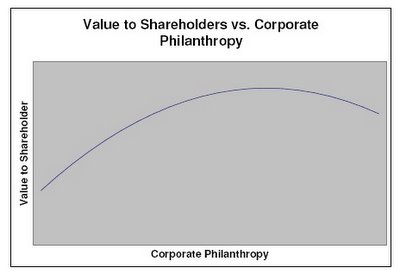 As the graph shows, some non-zero level of outlays in support of philanthropic causes will increase share holder value. However at some level, those outlays cease to increase value and become a waste of the shareholders money. Where this inflection point occurs will vary from firm to firm and perhaps industry to industry and can only be determined based on the individual executive's judgment. I hope to elaborate on the considerations of this process in future posts.
Nonetheless, at this point I will comment that philanthropy should not be used as a kind of insurance policy. Corporate philanthropy should be used in cases where corporate and philanthropic objectives align, not to curry favor with the public in the event of a scandal. The best insurance policy against a scandal are strong internal accounting controls and a culture that promotes ethical business dealings.
Ski Selection

A while back I mentioned that I was looking for a new pair of skis for this season. Well I may be a little late in providing an update, but better late than never. For the past couple of months I have been riding Dynastar's Legend 8000. They are really a great ski for the style of skiing that I enjoy most i.e. able to make quick turns across the fall-line or through a mogul field but also able to float in the power. I really got a good chance to learn about my new ski's performance in the powder while skiing in Whistler, BC. They had a ton of fresh powder three of the five days that I was out there. Although the 8000's did not float as well as a true powder ski they held up very well and certainly will perform better than any powder ski in New England ice! I highly recommend these skis to anyone interested in a great all mountain ski.
Congratulations Sgt. Wasilewski
My friend Josh Wasilewski has recently been promoted to Sergeant in the Ocean City Beach Patrol, where I work part time in the summers. This is a picture that I took of Josh last summer before we went to work.
Here is another picture of Josh on the OCBP's website along with his biography!
Also congratulations to the other three newly promoted Sergeants: Ryan Cowder; Jamie Falcon, and Nick Thompson.
Imagine That A Contested Election
It seems like this might actually be old news, but it appears that the Republicans is actually going to run a candidate against Edward Kennedy in this year’s senatorial election. Four years ago, John Kerry did not have a Republican challenger in his election even though the Mitt Romney was running a strong campaign for governor. This year, Kevin Scott plans to challenge Kennedy. I doubt that Scott has much of a chance to beat Kennedy, but it will at least be nice to have a choice of candidates on Election Day.
Thursday, January 05, 2006
BCS Season
I am a little tired today after staying up after midnight for the past three nights watching some of the best college football of the season in the four BCS bowls. Each of the four games, Notre Dame vs. Ohio State, West Virginia vs. Georgia, Pen State vs. Florida State, and the Southern California vs. Texas provided excellent competition. The players really left everything that they had on the field.
I was a little disappointed with Notre Dame’s play against OSU. On offense the team did not really seem to be in synch with many dropped passes and way too little protection for the quarterback. Our defensive line was unable to get any pressure on OSU’s quarterback and the lack of blitzing meant that Troy Smith and his receivers had plenty of time to pick apart our secondary. On the positive side, Darius Walker had a number of great runs and showed that he can be a huge threat when he is healthy.
On the other hand, I was not disappointed at all with last night’s Rose Bowl. Texas and USC put on a great competition for the National Championship. I was impressed with Vince Young’s ability to make some tough passes, but was even more impressed with the way he seemed to effortlessly gain yards when scrambling away from USC’s defense. These teams were so evenly matched, and had both had such success during the regular season that there can be no doubt that these two teams were the best in the nation. Congratulations to Texas for their victory!
I was a little disappointed with Notre Dame’s play against OSU. On offense the team did not really seem to be in synch with many dropped passes and way too little protection for the quarterback. Our defensive line was unable to get any pressure on OSU’s quarterback and the lack of blitzing meant that Troy Smith and his receivers had plenty of time to pick apart our secondary. On the positive side, Darius Walker had a number of great runs and showed that he can be a huge threat when he is healthy.
On the other hand, I was not disappointed at all with last night’s Rose Bowl. Texas and USC put on a great competition for the National Championship. I was impressed with Vince Young’s ability to make some tough passes, but was even more impressed with the way he seemed to effortlessly gain yards when scrambling away from USC’s defense. These teams were so evenly matched, and had both had such success during the regular season that there can be no doubt that these two teams were the best in the nation. Congratulations to Texas for their victory!
Wednesday, January 04, 2006
Deciding to Withdraw Medical Care
I liked this post detailing concerns making decisions about how and when to withdraw medical care. In medical care, as in all other aspects of life, we constantly find ourselves required to make choices about how to allocate finite resources most effectively. The questions that Julian asks help to clarify the difference between economic justice and resource allocation that often become confused in the actual decision making process and in general debate:
There's one question about economic justice, whether someone has a share of resources we think is adequate to give someone a fair range of real options—to put food on the table and also, if she wants it, provide for medical insurance. There's a distinct question about how we react once people have disposed of just shares as they see fit and still find themselves in dire medical straits.
Tuesday, January 03, 2006
Compelling Interest?
Travis and Dobber posted an interesting collection of opinions about obsticales to enhanced school choice. Clearly everyone in this group believes that increased choice is imperative in the education market, but it seems that the group breaks into two divisions based on whether they believe that society, through government, has an interest in insuring that every person has some minimum level of education.
So, here is the question for you guys, does society, through government, have a compelling interest in guaranteeing that every person has a minimum level of education?
If the answer is yes, then tax funded charter schools and voucher programs are an appropriate solution to providing competition to government run schools. However, if the answer is no, then the tax funded primary and secondary education system should be privatized.
Thoughts…
So, here is the question for you guys, does society, through government, have a compelling interest in guaranteeing that every person has a minimum level of education?
If the answer is yes, then tax funded charter schools and voucher programs are an appropriate solution to providing competition to government run schools. However, if the answer is no, then the tax funded primary and secondary education system should be privatized.
Thoughts…
Wednesday, December 28, 2005
Great Speakers
Last week I found a great page on the university of Notre Dame Mendoza College of Business website that contains video of many of the business leaders who come to speak at the business school. When I was an MBA student, I often attended many of these events. Watching these the polish and poise of these speakers really encouraged me just like it did when I was a student. I hope that the University continues to make video of these presentations available on the site so that alumni and other interested people can benefit from them.
I have already spent a couple of hours watching and listening to
Tom Mendoza,
Jack Welch, and
and
Charles Phillips .
.
These gentle men are great examples for everyone in the business community to emulate.
I have already spent a couple of hours watching and listening to
Tom Mendoza,
Jack Welch,
andCharles Phillips
.These gentle men are great examples for everyone in the business community to emulate.
Thursday, December 08, 2005
Sullivan vs. Krauthammer
In recent weeks, many people have debated the legality and morality of United States Government agents torturing enemy combatants in the hopes of gaining critical information. While I certainly believe that torture is morally wrong, the real existence of people in the world who endeavor to destroy the United States along with my moral system makes the limits on interrogation techniques that we place on our government an important question. Last week Charles Krauthammer published an essay in the Weekly Standard arguing that the government agents should have the flexibility to employ torture in a couple of extreme conditions. Today Andrew Sullivan published a response in the New Republic in which he insists on an absolute ban on torture by the government. These two essays present the best cases that I have read on both sides of this issue.
My sense is that Krauthammer gets the better of this argument. Sullivan's strongest point is that totalitarian instruments have no place in a war for freedom. However, I think that this is overwhelmed by the real need for the government to have complete flexibility to defend its citizens from foreign enemies with out facing presidential impeachment.
My sense is that Krauthammer gets the better of this argument. Sullivan's strongest point is that totalitarian instruments have no place in a war for freedom. However, I think that this is overwhelmed by the real need for the government to have complete flexibility to defend its citizens from foreign enemies with out facing presidential impeachment.
Subscribe to:
Posts (Atom)

