Wednesday, August 31, 2005

Federalism and Hurricanes

Andrew Sullivan links to an interesting article about Federal Government funding for levy construction (or lack thereof) in the New Orleans area. Apparently, the administration diverted federal funds away from levy construction in New Orleans to pay for military spending in Iraq. In light of the recent hurricane, which caused floodwaters to break those levees this looks like a potential political problem for the President.

The final paragraph of the article states:

Local officials are now saying, the article reported, that had Washington heeded their warnings about the dire need for hurricane protection, including building up levees and repairing barrier islands, "the damage might not have been nearly as bad as it turned out to be."
This sounds remarkably like a breakdown in federalism. The local officials and their constituents in New Orleans are the ones being the most affected by the failure of the levees. They should be the people making decisions about levy construction and they should be the people to bear the political responsibility for raising taxes to pay for that construction. Andrew ends with the comment:

Yes, some would even blame Bush and the war for a hurricane. But blaming Bush and the war for the poor state of New Orleans' levees is a legitimate argument. And it could be a crushing one.
The supposed reason for the poor state of New Orleans’ levees is the Iraq War. Shouldn’t the management of the Iraq War be a higher priority for the President of the United States than the poor state of New Orleans’s levees? Shouldn’t the poor state of New Orleans’s levees be a higher priority for the local officials? Lets place responsibility where it belongs.

1421

I just finished reading 1421: The Year the Chinese Discovered America by Gavin Menzies. The thesis of the book is that in the years from 1421 through 1424, a Chinese fleet under Admiral Zheng He voyaged across the globe and discovered all seven continents – all seventy years before Columbus. Interestingly a Google search of 1421 China returns Menzies’ site as the number one site and returns a site called Debunking Gavin Menzies second. Clearly, controversy surrounds Menzies thesis.

The evidence in favor of the Chinese voyage is certainly interesting. Much of the evidence comes in the form of old maps containing coastlines that had not been explored by Europeans at the time of their drawing. In addition, Menzies presents evidence of apparent Chinese shipwrecks, Chinese artifacts, and Chinese populations (colonies) throughout the world.

Unfortunately, the style of the writing leaves much to be desired. Many of the book’s conclusions could better be described as stretches. Some are certainly plausible, but Menzies is not as careful as he could be about making his cases. Menzies really wants to believe his thesis so he presents his evidence in a way to make it fit – this comes through in the writing. The other convenient aspects of the thesis is that no written record exists of the Chinese voyage. The Chinese apparently destroyed all evidence of the voyage as they fell into self-imposed isolation, the fleets apparently did not visit Europe, and the Portuguese who apparently inherited the Chinese maps did not mention them directly in their writing. All in all Menzies book is certainly an interesting story, but one that I would prefer to see presented much more rigorously, and with more corroborating evidence.

Leaving aside some of the shaky evidence, this story highlights the importance of political stability to human accomplishment. If all the Chinese actually accomplished all that Menzies claims, they were hundreds of years ahead of the Europeans. That within a few hundred years, China was actually conquered by those same Europeans shows just how fleeting their accomplishments were. Interesting to contemplate when viewing history on a scale of centuries, but hard to appreciate in our fast paced daily lives.

Lawyers vs. Businesspeople

The $253 million judgment against Merck in the recent Vioxx case provides me with a great opportunity to comment on the differences between lawyers and businesspeople.  While both groups are routinely castigated in public opinion for being greedy and unconcerned for the plight of their fellow citizens, these people drive our economy and provide the backbone for our country’s economic health.  Although both lawyers and businesspeople contribute to our country’s economic success, they contribute in vastly different ways.  Business people primarily use their creativity and leadership to create value, while lawyers use their knowledge of the law and contracts to defend or to redistribute value.  

Businesspeople use their knowledge of their customers as well as knowledge of some specific technical subject to create and sell products and services that bring unique value to their customers.  In return for creating that value for their customers, the business people and their firm capture a portion of the value that they created for their customers in the form of profits.  Changing customer preferences, technological advances, and relentless competition make the quest to capture profits an ongoing process.  Businesspeople must continually identify and develop new ways to serve their customers or risk losing their position to the competition.  

In contemporary business, almost every activity requires input from multiple individuals who have specialized skill sets - in many cases, these individuals may even work for separate firms.  In order for these groups to perform effectively, business leaders must coordinate activities and motivate the group.  The ability to organize a group of individuals into an effective team defines leadership in many areas and especially in business.  Business people and their companies require effective leadership and creativity to serve their customers well, which creates value.  Business people can defend their positions well in the marketplace but need help in the courthouse.  

The United State’s legal system provides an environment in which individuals and firms can freely contract and seek remedy for transgressions.  Absent this environment, the best efforts of business people could easily be lost without redress.  Lawyers use patents, copyrights, contracts, and lawsuits to defend the value created by businesspeople.  Without patents and copyrights others could benefit from a firms creative new ideas and inventions.  Without effective contracts, other parties would not have to honor their business agreements.  Both the threat of and an actual lawsuit provide incentives for others to act in accordance with the laws with respect to a particular firm.  All of the activities that lawyers perform serve to keep the value that businesspeople create within their firm.  Lawyers do not create value; they protect it.  

Unfortunately for Merck, their lawyers did not succeed in defending the value that Merck’s creative scientists, marketers, and production organization created with Vioxx.  Whether justified or not, this judgment will clearly affect Merck’s future investment decisions, likely reducing the number of creative new drugs entering the market.  Regardless of how successful a firm is in developing attractive new products, unless it can expect to retain the value created thorough its efforts the firm will not succeed in pleasing it’s stakeholders.  

Tuesday, August 30, 2005

Red Sox Game

Went to the Red Sox game last night with three friends, Mel, Pat, and Jody. Special thanks to all of the people who had seats on the third base line and decided to leave during the rain delay. It was great fun to have such a close view of the game - literally eye level with the players. Below are a few grainy pictures that I took with my mobile phone. The built in camera is ok for taking close up pictures in doors, but does not work well outside especially in tough lighting situations. Pictures aside, the Red Sox played a great game to beat the Devil Rays 10-6 with plenty of home runs to go around!

Red Sox

Bye Abe!

Monday, August 29, 2005

Thursday, August 25, 2005

Transportation Socialism Comments

A few days ago Travis posted an interesting essay on the unfortunate federal highway bill just signed into law. In general I agree with Travis’ conclusions regarding 1. Returning control of highway spending to the states, and 2. Exploring private ownership of roads. If there ever was a compelling federal interest in highway construction, it has ceased to exist with the completion of the interstate highway system. Returning decision making and tax authority to the state level will at least remove one layer of government and hopefully make the decision making process more accountable to tax payers. Going a step further, allowing private ownership of roads and compensating these firms via tolls will allow for price signals and consumer behavior to drive future investment. Also it will remove the government from the decision making process and allow individuals and firms to make the choices about what serves them best. For an interesting background article please take a look at this.

What I think that Travis misses in his essay is the fact that monopoly power is real. That the government (state and federal) currently has a monopoly over the highway system is not really a good argument for replacing one monopoly with another. The only good reason to privatize highways is to increase the efficiency of our highway system through incentives and competition. Clearly the public would not be well served if a single firm controlled all of the highway routes between two places. If this were the case that firm would price tolls higher and invest less than if a competitor operated an alternate route and each driver had a choice of with route to take.

My point is not that a private highway network is unworkable, but only that the government should have regulatory authority to ensure that no firm gains monopoly power over consumers. For example separate firms should operate interstates 95, 495, 93, and route 90 in the Boston area to ensure that drivers had multiple options to reach their destination.

In addition other modes of transportation such as railroads and air travel should be included in the definition of travel when assessing a firm’s market position. The CEO of Amtrak has stated that he believes that transporting people is only a marginally profitable business. How can this possibly be true? Americans travel constantly for business and pleasure and are willing to pay for that ability. The reason that the major airlines lose millions of dollars a day and that Amtrak needs over a billion dollars a year in government subsidies is that the transportation industry has been constrained and regulated too much by government. Freeing all modes of transportation from government control and only regulating enough to prevent monopoly power (which likely means not at all in many if not all markets) will enable private capital to improve our national transportation network and earn strong returns while they do.

Tuesday, August 23, 2005

Rip Currents

I have posted about rip currents and ocean wave theory before and recently I came across some interesting material describing some of the key causes of dangerous rip currents as well as well as the theory behind how rip currents form and how strong they become. The National Weather Service has some great resources on rip currents for anyone who does not know what a rip current is or how to identify one on their website.

The first paper, which is on the NWS’s rip current page, describes a study to improve forecasting of dangerous rip currents in Volusia County Florida. The study concluded that four factors contributed to the formation of dangerous rip currents – those rip currents that tended to lead to large numbers of rescues by local lifeguards. These four factors are: wave height, wave direction, wave period, and a tidal factor. The first two factors seemed pretty obvious to me because wave height and wave direction clearly play an important factor in the strength and formation of rip currents. The later two, wave period and the tidal factor, were interesting to me. I had not thought much about wave periods influencing rip current strength, but it certainly makes sense that:
Long period waves will be effected by the bottom at deeper depths and will break further from shore, resulting in a larger wave set up. Long period waves may also have significance due to their ‘groupiness’ creating pulses of the rip currents (Shepard and Inman 1950), catching bathers by surprise.

When I think back to days when I have made the most rescues, the majority of rescues tend to happen after a larger set of waves breaks over the sandbar. I would hypothesize that long period waves cause increased rescues due to 1. the increased strength of the rip current themselves and 2. the temporarily higher set up height which causes swimmers in relatively deep water to suddenly find themselves in water over their heads and hence become venerable to the currents.

The tidal factor undoubtedly plays a major role in the formation and strength of rip currents. This study found that 62% of rescues occurred during the 42% of the time when the tide was between 0.45 m and 0.75 m below the mean with 0.6 m below the mean being ideal. It is interesting that evidence from Volusia County shows this empirically. I would expect that the tidal component might be somewhat more complex than this because of differences in the structure of the ocean floor at various different beaches. The empirical study shows that when the tide falls below 0.75 m of the mean the number of rescues decrease, perhaps because of sandbar exposure. The tidal level where sandbar exposure begins likely varies from beach to beach and also over time at a single beach as the height of the sandbar changes.


I will not comment as much on the second article that I found here, which describes some ongoing research to determine the causes of rip currents and lists some hypothesis about why the form in the first place. Many people who swim in the Ocean have long been able to describe what a rip current is, how to identify it, and how to avoid and escape from one. It looks like science is still working to identify the underlying physics of why they from and how to predict where and when they will form.

Monday, August 22, 2005

Weekend at the Beach

I went to the beach, Ocean City Maryland, this weekend for another great long weekend.  While at the beach, I worked for the Beach Patrol.  The weather was great all weekend except for a few hours of drizzle on Friday.  Unfortunately the surf was very small, bordering on nonexistent so I could not surf in the mornings before work or the evenings after work.  Oddly enough the weather and surf conditions in the middle of August this year remind me more of the middle of July when the air is hot and the surf is small.  

The highlight of our weekend trip occurred at the Beach Patrol’s annual awards banquet where I received an award for ten years of service.  Amazing to think that I have been associated with an organization for ten years – as a lifeguard no less.  I intend to compose a more carefully considered essay on what I love so much about the Beach Patrol and post it here in the next few days to weeks.  For now, I think that it is enough to say that I had a great trip this past weekend and have loved all ten years of being a part of the Beach Patrol.  

Thursday, August 11, 2005

Breaking the 11th

In the Agora has declared August 11, 2005 Breaking the 11th Commandment Day, which is an opportunity for Republicans to criticize the Republican leadership currently in power. As a confirmed Republican, I am going to take this opportunity to express my concerns with the performance of those Republicans currently in power. Hopefully criticizing my own party will help strengthen it and demonstrate my intellectual honesty. Over the past four and a half years, the Republican leadership has let me down in three areas: limiting the size of the federal government and liberalizing the economy, and blurring the line between Church and State

Limiting the Size of the Federal Government

Republicans have traditionally been known as the party of limited government. From their position as the minority in congress the GOP opposed the big government programs from the New Deal to the Great Society. Ronald Reagan and Newt Gingrich continued this tradition and made the promise of limited government explicit although they did not have enough control over government to completely realize their objectives. With the election of George W. Bush, the GOP gained control of both the executive and legislative branches of the federal government so the ability to limit the size of government should be with their control. Unfortunately over the past four and a half years the federal government has expanded greatly rather than contracted. Nearly all areas of the federal government have greatly expanded their budgets even those outside the scope of homeland security. From bloated transportation and energy bills, to Medicare prescription drug entitlements, to the farm bill, to no child left behind, to Amtrak Republicans have spent government (taxpayer) money on programs far beyond the scope of anyone's definition of limited government.

Liberalizing the Economy

President Bush campaigned for office by telling voting Republicans that he would enhance our economic potential through tax cuts and more open trade with other countries. While the tax cuts and a few free trade agreements have been enacted, the administration has committed multiple missteps along the path to a truly liberal economy including steel and lumber tariffs and the farm bill. Steel tariffs were the first misstep and the first issue where I disagreed with this president. In addition to violating our commitments to other countries, they drastically raised the cost of steel, which hurt US consumers and especially US manufactures who must purchase steel. Likewise placing punitive tariffs on Canadian lumber only hurts US consumers and the housing industry. Finally the farm bill greatly expanded agricultural subsidies, which serve to distort our agricultural market and enrich US farmers at the expense of desperately poor farmers in other parts of the world. Each of these missteps has served to enrich special interests in the US (steelmakers, lumber industry, and agribusiness) at the expense of the average American consumer. In a truly liberal economy, consumers would benefit from greater competition and all sectors of industry would need become much more efficient.

Blurring the Line Between Church and State

On social issues the republicans in power have blurred the line between church and state too much for comfort. Although faith based initiates certainly stop federal programs from discriminating against religious charities, which is better than the previous status, ideally government should not fund any charities at all - individuals would. Forcing Federal involvement upon religion serves to cheapen the role of religion in society. Conversely, writing discrimination of gays into the constitution and Federal intervention in the Terry Schrivo situation are illustrations of Republicans allowing religion to master government. In the Byzantine world nearly constant state intervention in religion ultimately hurt the Orthodox Churches while in the west the Roman Church essentially took over the Roman Empire and culminated in corruption and reformation. We need to be vigilant about both of these relationships in the US. Church Religion needs a space separate from state, in which to operate in people's lives without the crushing weight of state intervention. Some Republicans seem to have forgotten.

Friday, August 05, 2005

Armor for Sleep

Went to a free concert at the Hatch Memorial Shell, which is on the beautiful Charles River Esplanade. WFNX put on the show, which featured Armor for Sleep (we missed the first band). The band has an interesting sound. They have a very heavy sound, but lighten it up with melodic chords. Many of their songs transition multiple times, which makes for an interesting effect. I was happy to hear this band in an open air environment, because in a club I am sure my ears would have been ringing at the end of the show (not that that is necessarily a bad thing). The concert was a nice treat in the middle of the week.

Tuesday, August 02, 2005

Ocean Waves

Last week I spent three days at Ocean City, Maryland, which is a beautiful resort town on the Atlantic Ocean. We had a little bit of a swell from Tropical Storm Franklin as it passed to the east. I have always enjoyed riding waves first on body boards and then on surf boards. Even when I do not have either of these I like to body surf the waves. The rush of catching a wave is an incredible feeling.

Once I had advanced far enough in physics and engineering to understand the properties of waves in general, I began to wonder about the physics of ocean waves in particular. From a brief search of the web, I found a couple of interesting sites that give explanations of how ocean waves form, how they propagate, and how the release their energy. The best overview discussion is here. A site with a little more math, but without quite enough physical background is here. A particular description of the formation of rogue waves is here. Please post references to any other descriptive or mathematical sites in the comments field.

Privacy

Travis makes an interesting comment regarding privacy in response to this post on the Digital Television Industry. I agree that many people may oppose this type of development on privacy grounds, however I can only describe their position as tenuous. The entire reason that television exists today is to allow advertisers to gain access to viewers. To assert that content and service providers should invest in creating and distributing programming to serve some public good (entertainment?) is counter factual. As corporations, service providers aim to maximize value for their owners so refining and targeting demographics, ultimately down to individuals is clearly in their interests for the reasons that I cited before.

From a consumer perspective, privacy can only serve as a waste of time and a waist of an opportunity to learn about valuable goods and services. Most Americans spend countless hours watching television, with almost half of that time spent watching commercial messages. What possible good can be served if majority of these messages are for products that the individual does not want because the advertiser does not know anything about the viewer? I want advertisers to know as much about me as possible so that they can pitch products that I actually value highly.

Privacy advocates often use class to argue for increased privacy. I presume that their argument would be that corporations would focus their resources on more affluent individuals at the expense of the less affluent. However, targeted advertising will make both rich and poor alike better off as advertisers of luxury goods target those who can afford them and advertisers of low cost goods target those who need to make their money go farther. Are their other arguments to make in favor of privacy over utility?

Monday, July 25, 2005

Delicious Dessert!


On Saturday Lori's friend Lee invited us to her family's home in Manchester by the Sea for a weekend party near the beach. After Lori and I returned from a trip to the beach (swimming in the 50 degree water) and a kayak trip in the harbor, we went to the local food store to purchase some food and drink to bring to the cookout at Lee's house. When we entered the store we noticed a man handing out samples of a desert that turned out to be Gaga's Original Lemon SherBetter. It turns out that the name really does say it all because this stuff really is better! The SherBetter is like lemon sherbet, but has a creamy taste that is similar to ice cream. It is really the prefect refreshment for a warm summer day. We wound up purchasing four pints to take back to the party. Just about everyone loved it. I now have a new favorite summer desert!

Miller Water Sports Camp


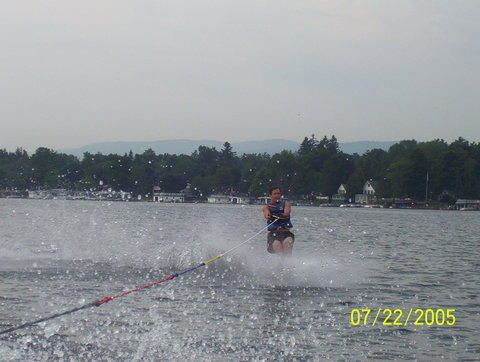
I spent last Friday with my friend Rob Miller at his parents' lake house in beautiful Lake George NY. The Millers were happy to host the first ever Miller Water Sports Camp, which was an intensive introduction to a variety of water sports including: water skiing, skurfing, skurfing, and tubing. This was only the second time that I have had a chance to water ski, which is unfortunate because it is a blast. The picture to the right shows my first ride on a single ski. The second picture show Rob, Kelli, and me all water skiing at the same time. Somehow we all managed to get up on the first try. It was really fun for all three of us to ride at the same time. Thanks again to the Millers for hosting.

Tuesday, July 19, 2005

Digital Television Industry

A few weeks back, I wrote about how technology looks likely to revolutionize the music industry by weakening the record companies who control distribution. The winners are likely to be the artists themselves who are able keep a larger percentage of the sales of their work and consumers who will have a much wider selection of artists available to them. I think that something similar will happen to the television industry as the distribution of content passes out of control of the broadcast networks and even the cable networks.

Clearly the average American, who subscribes to cable, has a much greater selection of programming available to him than twenty or even ten years ago. In addition digital video recording devices (like TiVo) allow viewers to watch programs at a more convenient time or even store those programs indefinitely. In the process consumers who use DVRs typically skip most of the commercial messages from the companies who paid to subsidize the program. The economics of the model are beginning to break down and the industry needs to create a new business model to survive.

Today, television programs are created by studios who are either a part of television networks or contract with television networks to air their programs. Studios pay all of the actors, writers, producers, and crew associated with the program. Television networks choose the shows they want to air at a particular time based on which programs they think will draw the most viewers. The reason that the networks want to draw the most viewers is so that they can sell commercial air time to advertisers at a higher price. Advertisers use the commercial air time to send a message to consumers about their products and services - usually to raise awareness of a product/service and to convince a customer to make a purchase. So fundamentally businesses fund television programming and networks in order to send a message to their customers and potential customers.

The current advertising environment is one of increasing audience fragmentation, which increases the complexity of identifying the programs that a target audience plans to watch. Then even if advertisers can identify the most desirable programs many members of the target audience may just skip the commercials with a DVR, which defeats the purpose of funding the program.

Technology is clearly changing the dynamics of the television industry, but the changes are not necessarily negative. In fact the technology that has thrown the profitability of the industry into question also creates new opportunities to create value. Advertisers still want to send a message with their customers - so much so that they are willing to pay dearly to do it. Consumers still want to watch television programs for entertainment and are even somewhat interested in learning about new products and services. All the television studios, actors, producers and other staff still enjoy making television programs and being paid to do it. All that is really needed is a new model to transfer value between all of these players, which will likely be driven by the firms that control the access to viewers and have relationships with studios and advertisers.

I can see two ways for this to play out. The first is for viewers simply to pay their service providers (cable companies or Bells in the future) for the programs that they want to watch. Many cable companies currently offer commercial free video on demand for certain programs so many consumers are already doing this. This model cuts out advertisers and likely results in a suboptimal solution i.e less value is created for everyone - specifically advertisers.

A superior solution would combine the benefits of video on demand with a targeted approach to advertising. The mechanism to offer video on demand is that a customer requests that their service provider send a particular program to their television. The service provider then sends that program. By definition, the service provider knows which viewer plans to watch the program. Assuming that they know something about that particular viewer, they will be in the perfect position to target specific advertisements that the viewer may be particularly interested in seeing.

The benefits for both the consumer and the advertiser are enormous. Advertisers spend countless resources trying to determine what kind of people are most likely to purchase their product and how they can find them to raise awareness. Instead of playing averages, they can just send their message directly to the type of people that they want. Instead of sponsoring a particular program, the advertiser can send a message to a particular person.

Two examples illustrate this point. Producers of feminine hygiene products waste huge sums of money buying air time for their commercials that are ultimately viewed by men. Although in many cases men and women watch television together, there are certainly plenty men watching television alone who will never purchase these products. The air time would be better spent advertising anything else, but since their target market is so large, fertile women, the companies do not mind paying extra money to reach them. The second example deals with the problem of a target market being too small for television. There are countless examples, but ski and snowboard equipment is a good one. There are essentially no commercials for ski equipment on television, although there are plenty of commercials for other products that feature skiing. The reason is that too few people purchase ski equipment to make it worthwhile for the companies to purchase commercial air time. They cannot have any assurance that they will be able to reach a large percentage of their target market regardless of which programs they sponsor.

The likely solution to both of these problems is for consumers to indicate not only who they are but which products and services they would like to learn more about. Then service providers and advertisers can target commercial messages directly at individuals instead of at groups. In fact if an advertiser can know that they are talking to a current customer, they may have a different message than if they are talking to a potential customer or a competitors customers. The ability to target an audience down to the individual level coupled with data mining and feedback from the viewers will make the investments that advertisers are making yield above average returns. Service providers will become an even more integral partner in business/consumer communications. Programming will improve to fit viewers tastes based on the actual decisions of consumers about what to watch. Technology posses significant challenges to this important industry, but it also allows the possibility to enhance value for all players involved.

Monday, July 11, 2005

The Catholic Church and Evolution

Last week, Cardinal Christoph Schonborn, archbishop of Vienna, submitted this opinion piece to the New York Times. The news department of the New York Times followed up two days later with this piece, which raises questions about how the Catholic Church views evolution. Both the original opinion piece and the news article, which it spawned, strike me as unhelpful in the search for truth.

Cardinal Schonborn, like many other religious leaders, has waded into the murky waters at the intersection of religion and science. Both religion and science profess to search for truth in our world, so both should be described as a process rather than a conclusion. Tellingly, both religion and science fall into error the later relationship is reversed.

My position as a Catholic and as a scientist (OK engineer) is that religion and science cannot ever be in fundamental conflict. I believe that there is a God who created the world, set the physical laws of our universe, and continues to operate in our world in accordance with those laws (many of which we do not yet understand). Science is a quest to better understand the physical laws which govern our universe, so because those laws were created by God, it is a quest to understand God.

The biblical story of creation is as much about the beginning of free will as about the creation of the world. In a sense, the creation of free will motivates the entire reason for creating a universe. God created mankind to enable a loving relationship between Himself and each individual. God loves each of us unconditionally and calls us to love Himself in return through grace. Due to humanity's inability to enter fully into this relationship, the Father send Jesus into the world to serve as the prefect example of love and to provide an easier path to God through the resurrection.

The current understanding of evolution is that all species have a genetic variation with respect to their physical form and capabilities. Certain of these variations allow individuals or groups to prosper within their given environment more than individuals that have different variations. Over the course of generations, the effects of positive variations allow will allow a species to prosper in its environment and the original variation becomes a trait of the species. Given this process and assuming subgroups of a species are unable inter-breed, the two subgroups are likely to diverge (different environments) and ultimately not be able to produce viable offspring. Thus creating to separate species.

Where is the conflict with the story of creation and the current theories of evolution and natural selection? If God's objective is to create a being who posed free will and had the ability to love and be loved by God, why is evolution not an appropriate mechanism?

Is there chance or randomness involved? Perhaps there is from our perspective, but we do not currently possess enough information to know for sure. With perfect information, it may be that a being with free will will inevitably result every time life forms. There may be some chance about the form end result, but it is entirely possible that a being with intelligence and free will would be very well adapted to its environment and at over 6 billion strong, the human species' experience supports this.

Cardinal Schonborn quotes Pope Benedict as stating that, "We are not some casual and meaningless product of evolution. Each of us is the result of a thought of God. Each of us is willed, each of us is loved, each of us is necessary." To this I say, "Yes!" That is God's purpose. God wants us to exist and to love him. Unfortunately earlier in his essay, Cardinal Schonborn states:

Evolution in the sense of common ancestry might be true, but evolution in the neo-Darwinian sense - an unguided, unplanned process of random variation and natural selection - is not. Any system of thought that denies or seeks to explain away the overwhelming evidence for design in biology is ideology, not science.

Why is it not true that an "unguided, unplanned process of random variation and natural selection" cannot be the mechanism by which God created man. It is not the system that seeks to deny God a place in the universe. Atheists do that. That they use a scientific theory to assail God does not mean that the proper response by intellectual Christians is to attach science. The Cardinal should redirect his rhetoric against the people who would use science against religion. Attacking science with religion is destined to be counter productive and worse confusing to the faithful who choose not to enter into the minutiae of the debate.

A few years back I notice a Darwin Fish on the back of a car. The person who put it there was likely and atheist and likely intended it as a jab at a framiliar Christian symbol. I liked it because I think that it expresses a truth about the relationship between religion and science: they are one in that they both search for truth and they are one in that symbol.

Janice Rogers Brown

Travis compiles a great list of quotes from recently confirmed DC Circuit Court Justice Janice Rogers Brown. With the political showdown over Supreme Court vacancy imminent, this type of research will help inform the debate. It is much harder to paint someone as an extremist when his or her record is on display for all to see. Does anyone know if a similar list of quotations is available for some of the other people supposedly on the short list?

Wednesday, July 06, 2005

A Creed for a Country

Two days ago we celebrated the 4th of July, when we remember the foundations on which our country rests. In this essay, Andrew Sullivan recalls the ancient principles of life, liberty, and the pursuit of happiness to offer a succinct interpretation for the proper role of government in human society. America, he says like many before him, offers the best hope to achieve human fulfillment.

Tragedy in the Ocean

CNN reports on a tragic end to a Fourth of July vacation for two men in Hampton, NH. The two men entered a rip current, along with about ten others, to attempt to rescue a child caught in the current. Instead of saving the child, they became victims themselves. Although the Hampton Lifeguards were off duty at the time, they responded and were able to rescue everyone except for the child's father and another man, who were pulled unconscious from the water. From the CNN account, it appears that the guards did a great job once they returned to the scene.

Unfortunately, this type of incident occurs far too frequently on beaches around the world. The general public simply does not appreciate the power of the ocean. People regularly swim in un-guarded surf and do not know how to recognize and escape from rip currents. What makes this incident particularly appalling is that the guards had been keeping people out of that rip current all day, but as soon as they went off duty, these people jumped right in. The message to the public should be to always swim near a lifeguard and not to enter a rip current unless a person is very experienced in the surf.

Also of note in the article is the misuse of the words rip tide and undertow. A rip current killed those two men. A rip current is formed along a beach or next to a rock jetty when water uses a break in a sandbar to return out to sea after being pushed to shore by a wave. A rip tide is associated with the tides when a inland body of water (river or bay) meets an ocean. When the tide is falling, water will flow from the inland body of water into the ocean. When the tide is rising water will flow from the ocean into the inland body of water. Rip tides regularly change direction with the rising and falling tides, while rip currents always pull away from shore. There were likely not tidal effects in the two drowning. Undertow does not exist. Many people commonly refer to rip currents as undertow because they can feel the pull of a rip current more strongly on their feet than on their upper body. However, rip currents do not pull people under the water, they pull people away from shore. It is only as the swimmers become exhausted or begin to panic that they drown.

I hope to take a trip up to Hampton in the next couple of weeks to check out the beach and hopefully talk to a few of the guards.